Benchmark Dataset for Catalysis on 2D MXenes
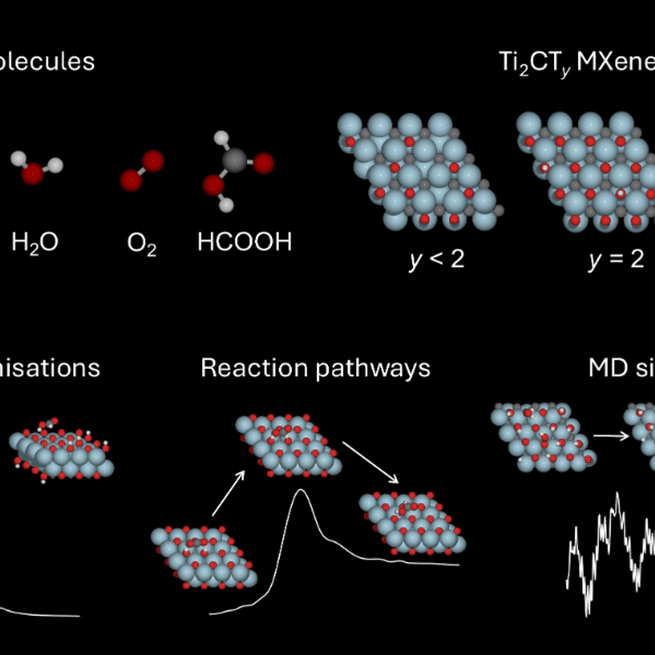
Merging first-principles calculations with machine learning (ML), we aim to accelerate the exploration of catalytic behaviour in novel materials. We focus on two-dimensional (2D) Ti2CTy MXenes, whose versatile surface chemistry makes them particularly compelling candidates for catalysis. Resolving their composition and structure under realistic conditions exceeds the reach of standard density functional theory (DFT) due to computational cost. To address this challenge, we generate a comprehensive dataset of 50,000 DFT calculations for training and 10,000 for testing, encompassing both Ti2CTy MXene configurations and molecular systems, along with an additional test dataset with 1000 genuinely new, larger systems to investigate how well models generalise. We train and validate widely used and competitive machine learning interatomic potentials (MLIP) models, EquiformerV2, MACE, MatRIS, UPET, and MatRIS that accurately predict atomic forces and formation energies — quantities that DFT must repeatedly compute for structural and catalytic investigations — for these 2D materials. This combined DFT–ML framework achieves computational acceleration of the order ∼1 − 4 · 103 (on a CPU) while maintaining desired-level accuracy (∼±10 meV/A for forces and ∼±1 meV for per-atom energies), paving the way for more efficient investigations of MXene catalytic behaviour. Moreover, we perform an extensive qualitative evaluation of the trained models, showcasing the importance of the comprehensive simulation-based comparison beyond the benchmark metrics. The dataset and the trained models with the code are available at https://huggingface.co/datasets/CatalystAnonymous/catalyst_mxenes.
May 30, 2026
On the Role of Rotation Equivariance in Monocular 2D-to-3D Human Pose Lifting
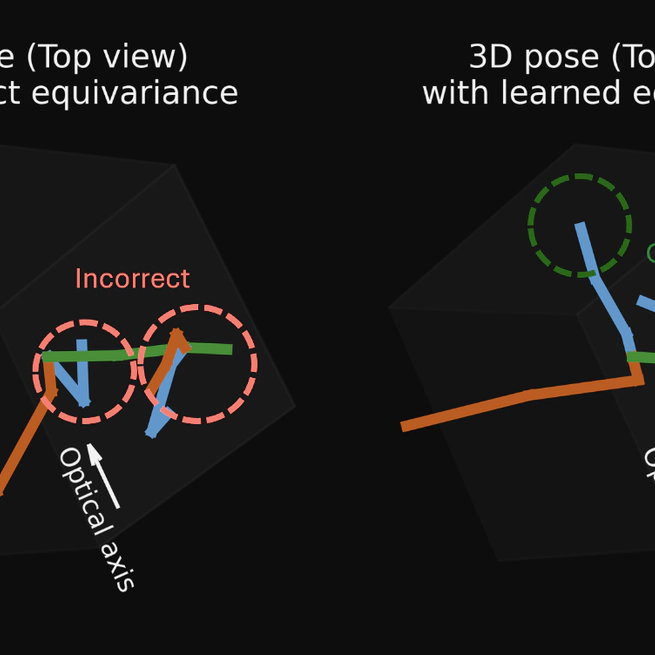
We consider monocular 3D human pose estimation (HPE), where the goal is to predict 3D human skeletal joints from a single 2D image, typically via 2D keypoint detection followed by 2D-to-3D lifting. Despite their success, we find that current lifting models exhibit strong performance degradation under rotations. We systematically study rotation equivariance across lifting architectures with increasing degrees of equivariant inductive bias, and investigate whether equivariance should be enforced by architectural design or learned from data, given the inherent ambiguity of monocular 2D-to-3D lifting. Utilising common HPE benchmarks, we demonstrate that rotation equivariance can be effectively learned via rotation-based data augmentation applied jointly to input and output poses. Compared with non-augmented models, this reduces error on rotated poses by over 30% across the benchmarks, with reductions of up to 72%. Moreover, augmentation-based models achieve up to 15% lower error than methods that are fully equivariant by design, while providing up to 37$\times$ faster inference. We further show that these findings generalise to real-world human pose sequences involving full-body rotations and to a state-of-the-art HPE model.
Jan 20, 2026
Learning to Augment: Hallucinating Data for Domain Generalized Segmentation
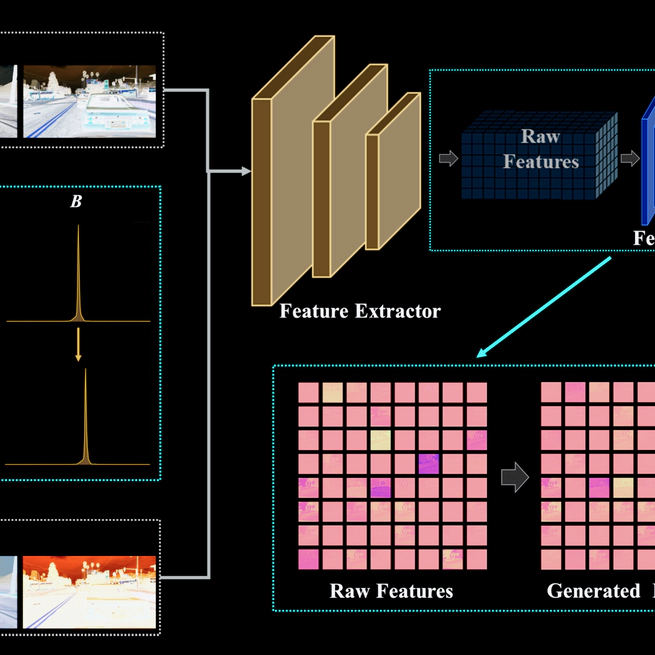
Domain generalized semantic segmentation (DGSS) is an essential but highly challenging task, in which the model is trained only on source data and any target data is not available. Existing DGSS methods primarily standardize the feature distribution or utilize extra domain data for augmentation. However, the former sacrifices valuable information and the latter introduces domain biases. Therefore, generating diverse-style source data without auxiliary data emerges as an attractive strategy. In light of this, we propose GAN-based feature augmentation (GBFA) that hallucinates stylized feature maps while preserving their semantic contents with a feature generator. The impressive generative capability of GANs enables GBFA to perform inter-channel and trainable feature synthesis in an end-to-end framework. To enable learning GBFA, we introduce random image color augmentation (RICA), which adds a diverse range of variations to source images during training. These augmented images are then passed through a feature extractor to obtain features tailored for GBFA training. Both GBFA and RICA operate exclusively within the source domain, eliminating the need for auxiliary datasets. We conduct extensive experiments, and the generalization results from the synthetic GTAV and SYNTHIA to the real Cityscapes, BDDS, and Mapillary datasets show that our method achieves state-of-the-art performance in DGSS.
Sep 12, 2023