Pavlo Melnyk
Pavlo Melnyk Paulus • Molendinarius

Postdoctoral Researcher

De Structura

I study symmetry, structure, and equivariance in machine learning, developing geometric representations that bridge learning systems with the structure of the physical world.

I’m currently a postdoctoral researcher in the division of Computer Vision and Learning Systems, Linköping University, where I previously earned my PhD in Electrical Engineering with a specialisation in Computer Vision, focusing on Geometric Deep Learning. I was supervised by Michael Felsberg and funded by WASP. Further details can be found in my CV.

Interests
  • Geometric Deep Learning
  • Scientific ML
  • AI for Good
  • 3D Vision
Education
  • PhD Computer Vision

    Linköping University, Sweden

  • MEng Computer Science and Technology

    Hunan University, China

  • BEng Information Security Systems

    DonNTU, Ukraine

Featured Publications

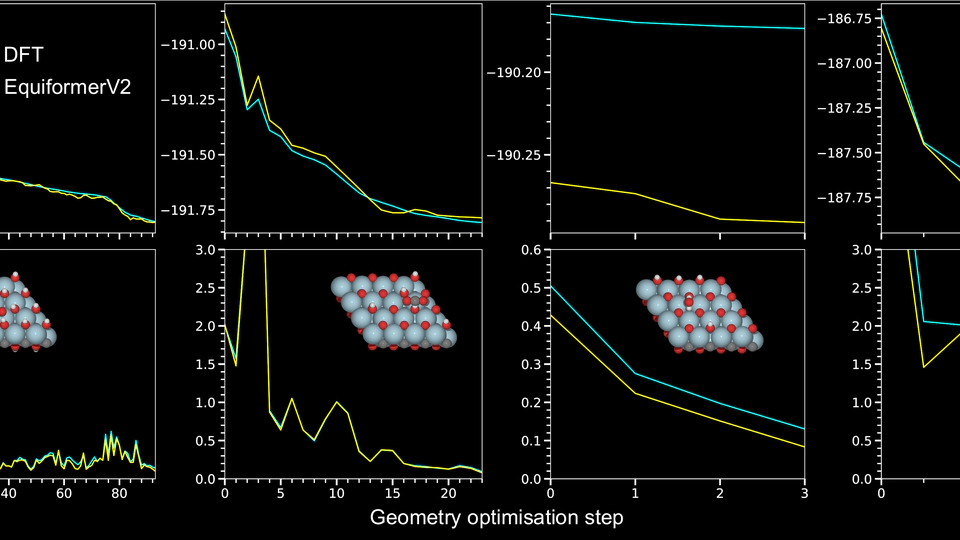
Equivariant Modelling for Catalysis on 2D MXenes

Merging advanced computations with machine learning, we aim to accelerate the exploration of catalytic behaviour in novel materials. We focus on two-dimensional (2D) Ti$_2$CT$_y$ MXenes, whose versatile surface chemistry makes them particularly compelling candidates for catalysis. However, resolving their composition and structure under realistic conditions requires going beyond the systems typically studied with density functional theory (DFT), as the computational cost of such calculations limits accessible system sizes and timescales, calling instead for more efficient approaches. To address this challenge, we generate a comprehensive dataset of 50,000 DFT calculations for training and 10,000 for testing, encompassing both Ti$_2$CT$_y$ MXene configurations and molecular systems, along with an augmented dataset where systems are artificially repeated to investigate how well models generalise to larger systems.Employing advances in geometric deep learning, we train and validate an equivariant (\ie symmetry-aware) model (EquiformerV2) that accurately predicts atomic forces and formation energies — quantities that DFT must repeatedly compute for structural and catalytic investigations — for these 2D materials. This combined DFT–ML framework achieves computational acceleration of the order ${\sim}10^3$–$10^4$ (on a CPU) while maintaining DFT-level accuracy (${\sim} {\pm} 45$ meV/Å for forces and ${\sim} {\pm} 6$ meV for per-atom energies), paving the way for more efficient investigations of MXene catalytic behaviour. Moreover, we confirm that the total energy prediction error of the model grows linearly with the number of atoms in an input system, while the force error remains the same, which, along with the equivariant model design, is a necessity for a robust model. The dataset and the trained models with the code are available at \url{https://github.com/CataLiUst}.

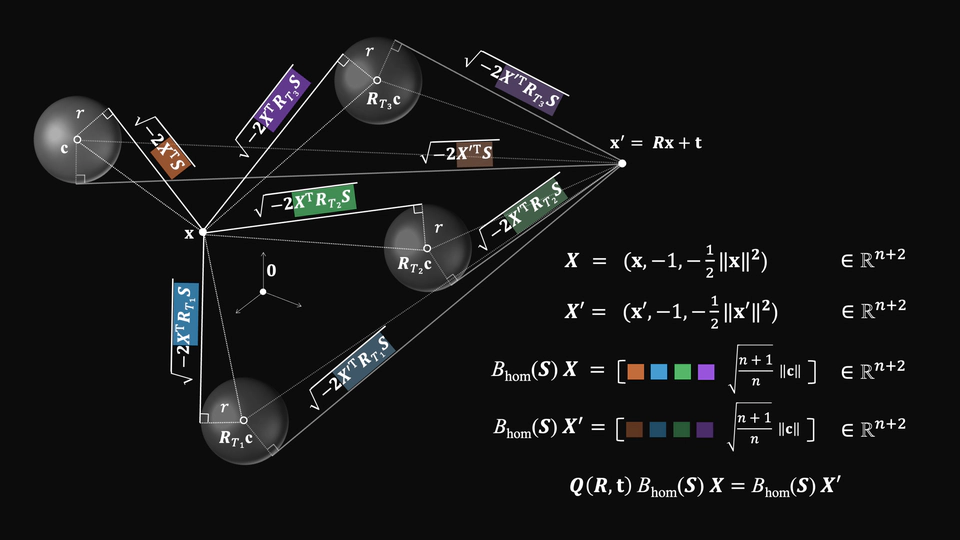
Embed Me If You Can: A Geometric Perceptron

Recent Publications
(2026). E$(n)$-Equivariant Spherical Decision Surfaces. ICLR 2026 Workshop GRaM.
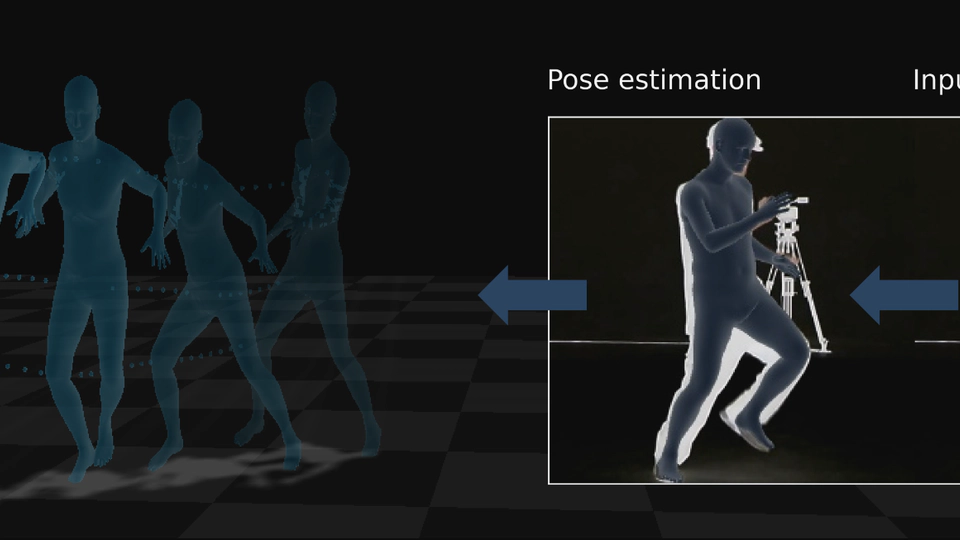
(2026). QuaMo: Quaternion Motions for Vision-based 3D Human Kinematics Capture. ICLR 2026.
(2026). Flow Matching for Probabilistic Monocular 3D Human Pose Estimation. arXiv preprint.
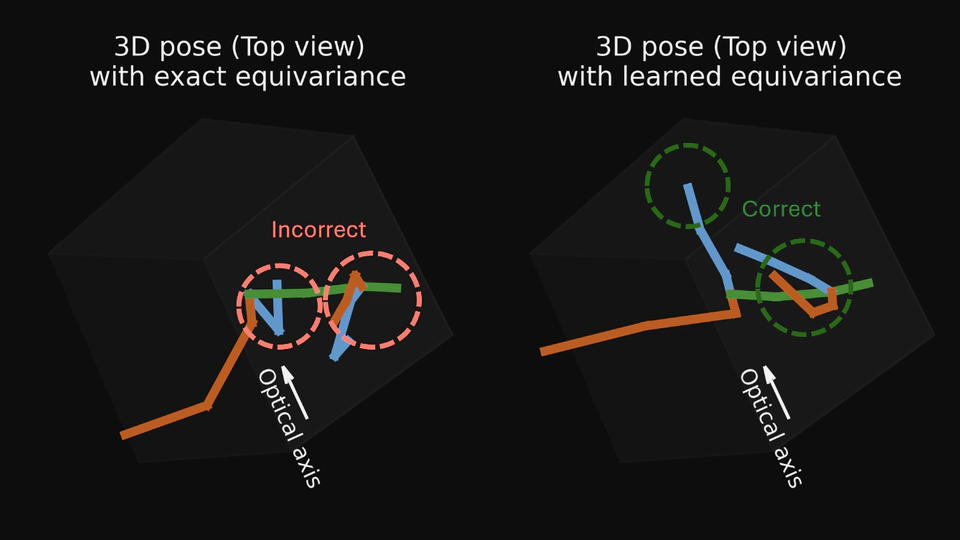
(2026). On the Role of Rotation Equivariance in Monocular 3D Human Pose Estimation. arXiv preprint.
(2025). Equivariant Modelling for Catalysis on 2D MXenes. EurIPS 2025 Workshop on SIMBIOCHEM Spotlight (non-archival).
News

Paper accepted at GRaM @ ICLR'26 (PMLR track)

“E$(n)$-Equivariant Spherical Decision Surfaces” has been accepted at ICLR 2026 Workshop on Geometry-grounded Representation Learning and Generative Modeling.

Paper accepted at ICLR'26

“QuaMo: Quaternion Motions for Vision-based 3D Human Kinematics Capture” has been accepted at ICLR'26.

WASP 10-Year Anniversary Feature

I was delighted to be interviewed and featured in the WASP 10-year anniversary article series.

PhD Graduation Ceremony

I had the honor of participating in the centuries-old tradition along with some extraordinary honorary doctors.

PhD Defense

On this day, I defended my PhD thesis on “Spherical Neur$\text{O}(n)$s for Geometric Deep Learning”.