Flow Matching for Probabilistic Monocular 3D Human Pose Estimation
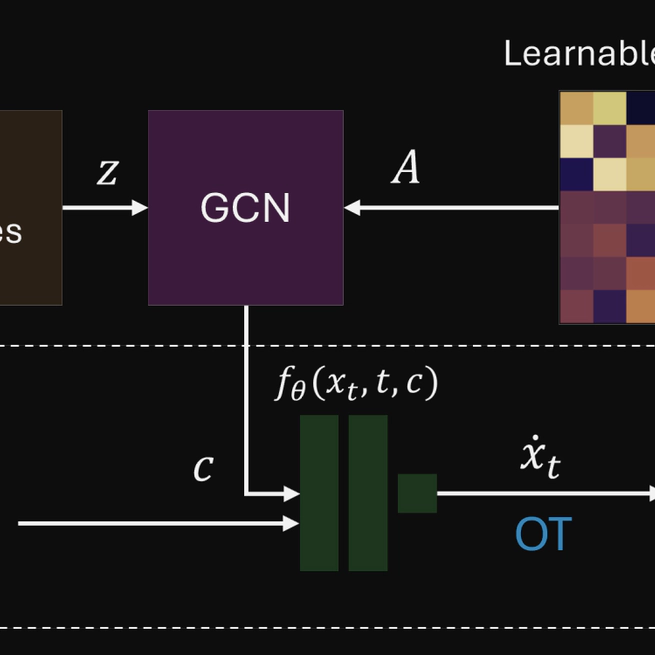
Recovering 3D human poses from a monocular camera view is a highly ill-posed problem due to the depth ambiguity. Earlier studies on 3D human pose lifting from 2D often contain incorrect-yet-overconfident 3D estimations. To mitigate the problem, emerging probabilistic approaches treat the 3D estimations as a distribution, taking into account the uncertainty measurement of the poses. Falling in a similar category, we proposed FMPose, a probabilistic 3D human pose estimation method based on the flow matching generative approach. Conditioned on the 2D cues, the flow matching scheme learns the optimal transport from a simple source distribution to the plausible 3D human pose distribution via continuous normalizing flows. The 2D lifting condition is modeled via graph convolutional networks, leveraging the learnable connections between human body joints as the graph structure for feature aggregation. While trade-offs between processing time and precision exist, already in the equal-accuracy comparison, FMPose exhibits significantly faster processing time than the diffusion model, and also offers another faster and more accurate configuration. Experimental results show major improvements of our FMPose over current state-of-the-art methods on two common benchmarks for 3D human pose estimation, namely Human3.6M, MPI-INF-3DHP. Additionally, FMPose shows competitive performance on the more challenging 3DPW dataset. The code implementation is available at https://github.com/cuongle1206/FMPose.
May 25, 2026
QuaMo: Quaternion Motions for Vision-based 3D Human Kinematics Capture
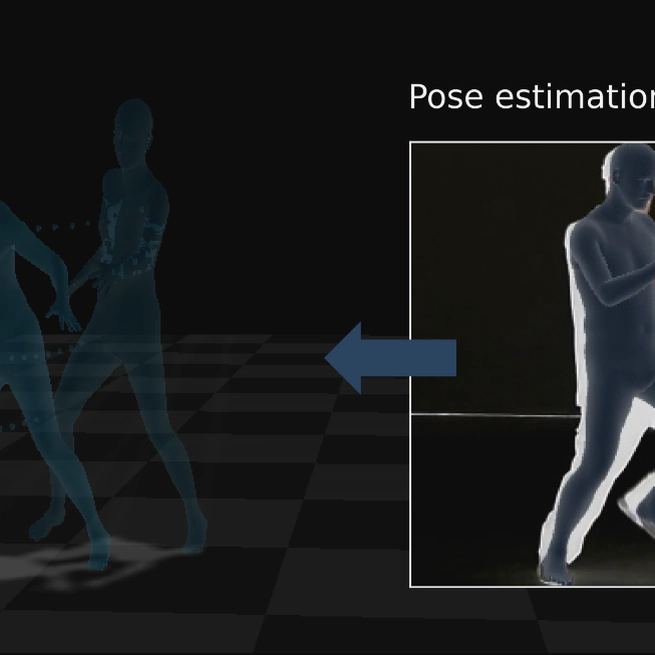
Vision-based 3D human motion capture from videos remains a challenge in computer vision. Traditional 3D pose estimation approaches often ignore the temporal consistency between frames, causing implausible and jittery motion. The emerging field of kinematics-based 3D motion capture addresses these issues by estimating the temporal transitioning between poses instead. A major drawback in current kinematics approaches is their reliance on Euler angles. Despite their simplicity, Euler angles suffer from discontinuity that leads to unstable motion reconstructions, especially in online settings where trajectory refinement is unavailable. Contrarily, quaternions have no discontinuity and can produce continuous transitions between poses. In this paper, we propose QuaMo, a novel Quaternion Motions method using quaternion differential equations (QDE) for human kinematics capture. We utilize the state-space model, an effective system for describing real-time kinematics estimations, with quaternion state and the QDE describing quaternion velocity. The corresponding angular acceleration are computed from a meta-PD controller with a novel acceleration enhancement that adaptively regulates the control signals as the human quickly change to new pose. Unlike previous work, our QDE is solved under the quaternion geometric constraints that results in more accurate estimations. Experimental results show that our novel formulation of the QDE with acceleration enhancement accurately estimates 3D human kinematics with no discontinuity and minimal implausible artifact. QuaMo outperforms comparable state-of-the-art methods on multiple datasets, namely Human3.6M, Fit3D, SportsPose and a subset of AIST. The code is available at https://github.com/cuongle1206/QuaMo.
Jan 26, 2026
On the Role of Rotation Equivariance in Monocular 2D-to-3D Human Pose Lifting
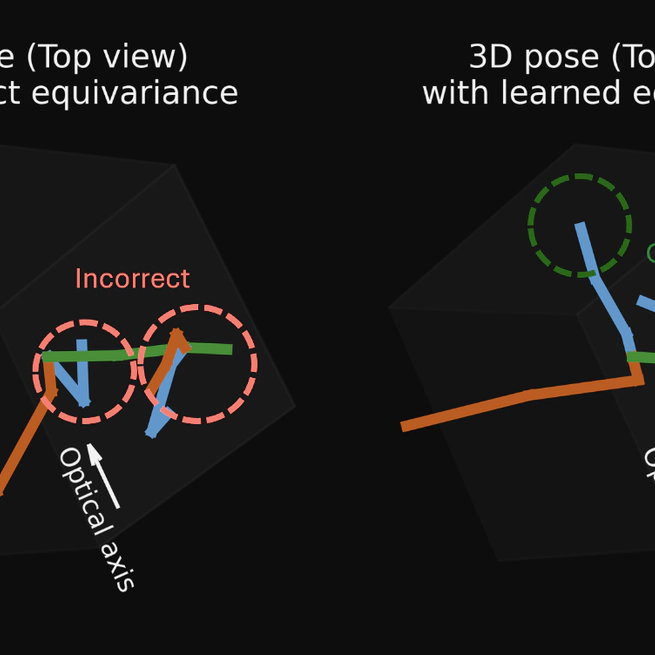
We consider monocular 3D human pose estimation (HPE), where the goal is to predict 3D human skeletal joints from a single 2D image, typically via 2D keypoint detection followed by 2D-to-3D lifting. Despite their success, we find that current lifting models exhibit strong performance degradation under rotations. We systematically study rotation equivariance across lifting architectures with increasing degrees of equivariant inductive bias, and investigate whether equivariance should be enforced by architectural design or learned from data, given the inherent ambiguity of monocular 2D-to-3D lifting. Utilising common HPE benchmarks, we demonstrate that rotation equivariance can be effectively learned via rotation-based data augmentation applied jointly to input and output poses. Compared with non-augmented models, this reduces error on rotated poses by over 30% across the benchmarks, with reductions of up to 72%. Moreover, augmentation-based models achieve up to 15% lower error than methods that are fully equivariant by design, while providing up to 37$\times$ faster inference. We further show that these findings generalise to real-world human pose sequences involving full-body rotations and to a state-of-the-art HPE model.
Jan 20, 2026